Right then, as promised (and do please remember I did admit that this wasn't the *best* example of my scholarly work!)..
1) BREED DESCRIPTION. This should include a description of what the sheep in this breed look like and their genetic composition.
Clun Forest originated as a breed in southwest Shropshire, near the forest whose name it bears, descending from a variety of mountain and moorland sheep that ranged over an area that has been described as one of the wildest and most desolate regions in England up to the middle of the 16th century. Their ancestors were commonly small and reddish brown in color with prominent eyes and may originally have been bred by pastoral or semi-nomadic shepherds as many as 1,000 years ago.
As the English economy shifted away from wool production toward more demand for meat in the mid-19th century, commercial flocks were often drained of breeding stock, which shepherds often replaced by introducing mountain ewes to their flocks. This practice resulted in vast genetic diversity in the modern breed, and is likely responsible for the continuation of those attributes which make the Clun Forest so desirable – adaptable, hardy, prolific, and content to forage for the bulk of its food. By the mid-20th century, Clun Forest was the third most numerous pure breed in Britain.
Clun Forest were first imported to the American continent in 1970 by Tony Turner, who brought in 2 rams and 39 ewes from Ray Williams, and sheep from Tony’s first flock were purchased by United States breeders at the 1973 Nova Scotia Sheep Fair in Truro. North American acceptance of the breed, however, was slowed by the lack of University sponsorship & promotion and a general lack of interest in grassland farming. Nonetheless, Angus Rouse of Nova Scotia secured two additional importations of Clun Forest after Tony which helped secure the breed in North America. In recent years, severe restrictions on the importation of livestock from overseas have prompted breeders to import Clun Forest semen from Europe in order to expand the genetic base of American flocks.
The first documented description of the modern Clun Forest breed is from the middle of the 19th century and describes them as white-faced and hornless. More recent descriptions, from the breed’s “Golden Age” between 1950 and 1970, reference the distinct woolen top knot, brown face with wide-set eyes, and small-to-medium ears held upright. The breed has changed little since its Golden Age, though modern Clun Forest may have slightly higher-set ears and darker brown faces. The typical Clun Forest ewe weighs between 130 and 160 pounds, with rams only slightly heavier – between 175 and 200 pounds.
The standard for Clun Forest as determined by the North American Clun Forest Association is as follows:
Head and Face
- A clean open faced sheep ranging from tan to black; top of head nicely covered and free from dark wool.
Ears
- Not to long and carried high.
Body
- Strong, muscular neck, lengthy good back, deep rib, strong loin, good hock, deep and well-rounded thighs, good through heart, strong bone, standing square on its legs.
Legs
- Fairly free from wool from hock and knee down.
Wool
- A tight fleece, fine texture, free from kemp and dark or gray wool.
Skin
- A nice pink or red skin, free from black or blue spots.
A sheep which meets you with a good head and a bold walk, that stands squarely on its legs, with plenty of heart girth and a good constitution.
2) FIBER CHARACTERISTICS: This should include, as a minimum, staple length and crimps per inch. Also include diameter or count (if known), whether the fleece you are using came from a lamb, hogget or mature sheep, and whatever else you can think of.Clun Forest fleeces – usually about 6 to 8 pounds when mature – are considered the finest fleece produced in Great Britain. They are consistent from neck to britch, with little or none of the variance common among other fleeces. Fleeces are essentially free from black or kempy fibers and are easily worked by handspinners, especially beginners, due to their density and uniformity.
Average staple length: approximately 4 inches
Crimp: Tight, irregular; well developed; elastic; extremely springy
Spinning Count: 46s to 54s (USDA wool grade); 58s according to some sources
Diameter: 28-33 microns
The wool in this sample is from two lamb fleeces (combined grease weight of approximately 4.5 pounds) sheared in late summer 2006 at Bets Reedy’s farm just outside of Money Creek, MN.
3) METHOD OF PREPARATION: What do you think is the best method of preparation for this breed - carding, combing, or commercial.I found little information on preferred methods of preparation for Clun Forest fleeces and as I did not prepare the fleece for this project myself, can add no significant personal insight.
An article written by Jane Fournier for the Fall 1993 issue of Spin-Off Magazine indicates that hand carding and drum carding are usually more efficient than flick carding and combing. Jane recommends a fine drum (320 points per inch) to avoid neps.
I also found the following account posted by
Cindy W. on the Yarnspinners blog, which I found informative:
The sample I worked with was a washed off white fleece. It had a large amount of VM in the sample. The wool had a soft hand with a very springy feel to it.
This fleece was surprisingly easy to comb or card. It seemed perfectly suited for my small hand held combs, coming off in a very nice top. Since I had seen in other fibers that fleece that combs well often does not card well, that was what I expected. But I was very surprised to find that Clun Forest also carded up into lovely batts with my hand held cards.
4) SPINNING TECHNIQUES: What special techniques, if any, are recommended for this breed?Other than several statements about the superiority of Clun Forest fleeces for handspinners, there was little information available recommending any specific spinning technique. Again in
Jane’s 1993 article, she mentions that Clun Forest fleeces lend themselves well “to traditional woolen-spun yarns. . . [and] results in a very bouncy, lofty, and slightly irregular yarn.” When spun “from a parallel preparation using a short draw, the lively and amphatic crimp results in a slightly fluffy, irregular yarn with a flat, chalky surface . . . [that] is lightweight and has great life and body, in contradiction to its dense appearance.” Finally, Jane notes that Clun Forest can be blended “with less-elastic fibers” such as kid mohair, alpaca, llama, or tussah silk “to produce yarns with body and bounce.”
Cindy W. from the Yarnspinners blog compares the yarn resulting from combed top and carded batts as follows:
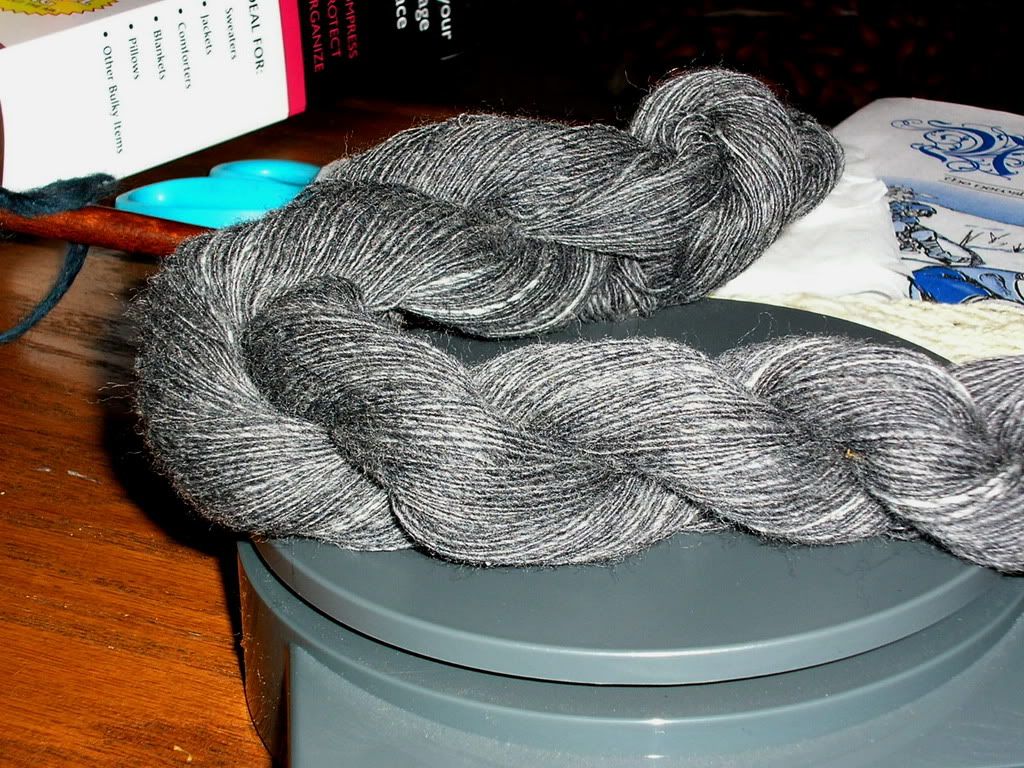
Combed top: This was a delight to spin. It drafted easily into a long draft, and gave a nice smooth fine yarn. The only thing I observed was that it was such a smooth yarn, that it was difficult to make joins, when I started a new piece of top. I also noticed that this fiber needed a high twist, and that it really was unwilling to hold the twist. I especially saw this when I was plying, that the thicker areas in the singles were almost unspun. It was also interesting to observe that the yarn really expanded once there was no tension on it. I measured this sample of yarn as 15 WPI. It was a very generous, 25 yard sample.
Carded batts: I used more twist while spinning this. I tried two types of drafting, a moderate drafting zone gave a thicker yarn, with the neps often disappearing right into the yarn. An inchworm draft gave a much thinner yarn, but I had to stop and pull out the neps, which slowed down the spinning. The neps were not in the combed top, making it the better prep. This skein was 14 yards which measured 13 WPI, and was a very nubby looking yarn.
5) RECOMMENDED USES: What types of uses are appropriate for this type of fleece?Depending on the preparation, Clun Forest wool is recommended by
Jane for “hosiery, flannels, knitting yarns, tweeds, and industrial felts.” The yarn – which is “very bouncy, lofty, and slightly irregular” – can be woven as singles or plied and knitted into “hard-wearing, cushiony socks or gloves.” Jane also notes that felt produced from Clun Forest wool is elastic and quite substantial and would make a good blazer or lightweight jacket.
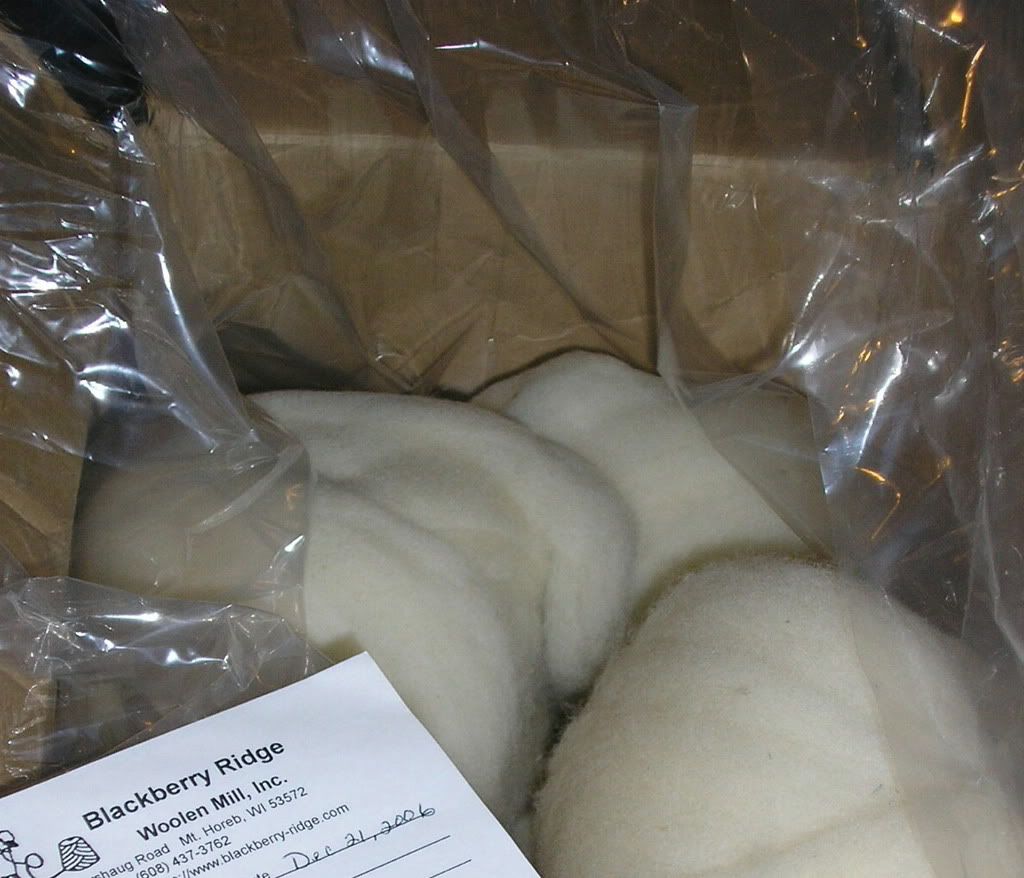
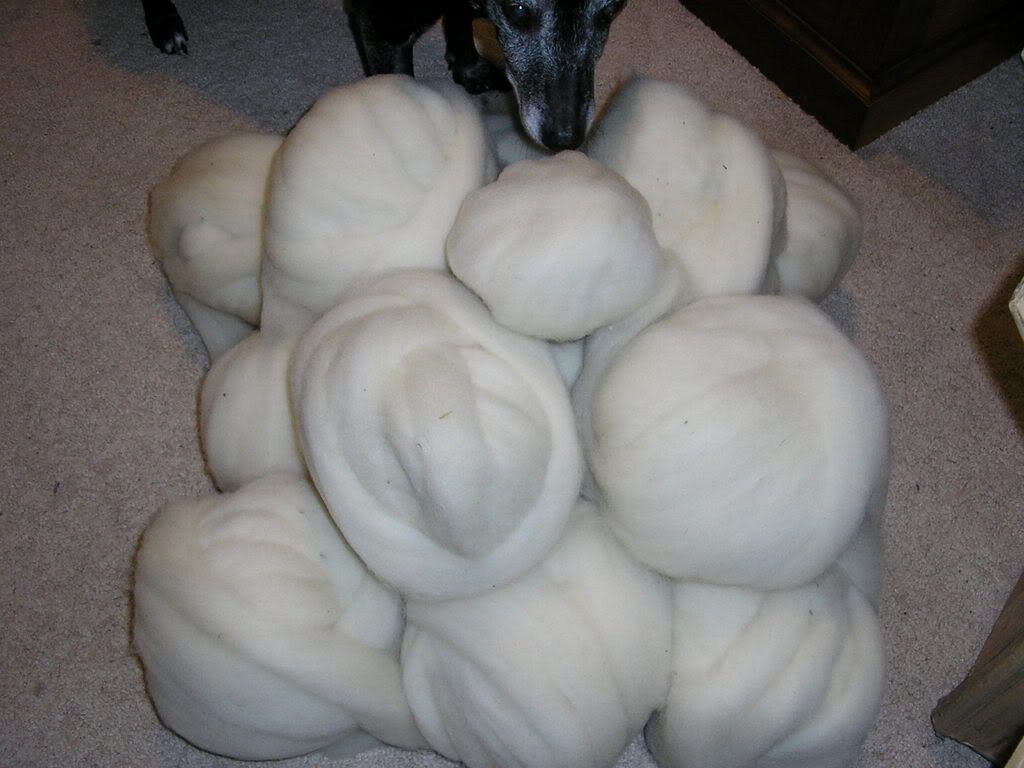
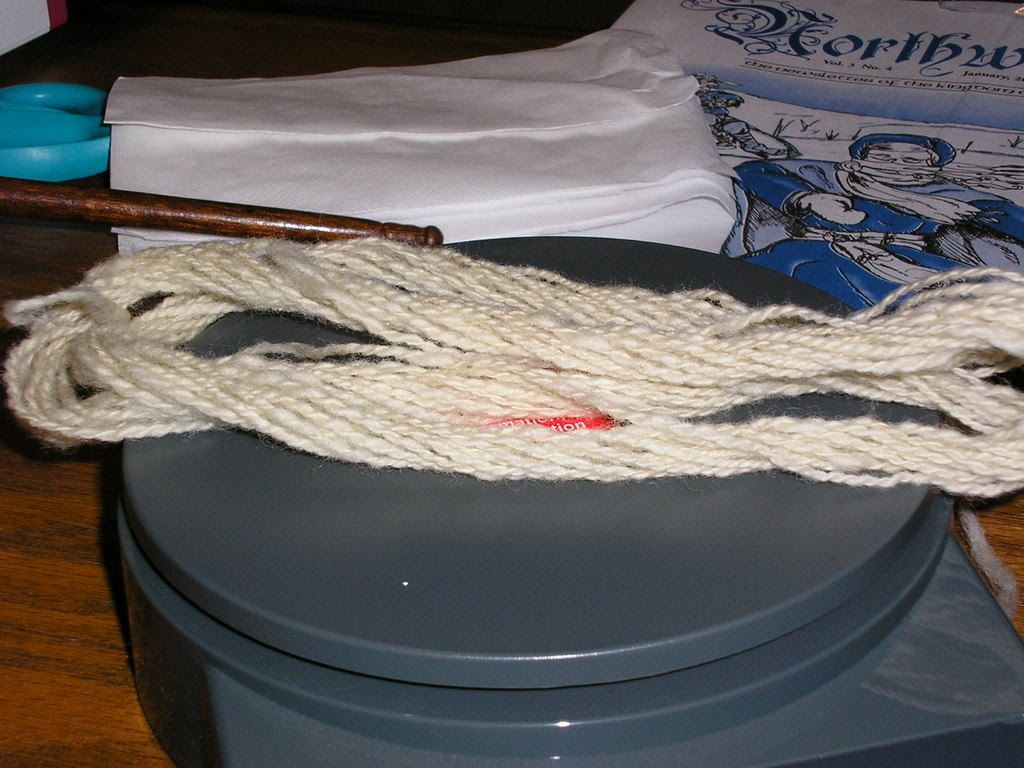
6) PURCHASE INFORMATION: Where did you purchase this fiber? If possible, provide name and address of vendor, and the price paid.As previously mentioned, the fiber included in the Breedswap binder is from two lamb fleeces sheared in late summer 2006 on Bets Reedy’s farm. Bets does not typically sell her fleeces directly (I obtained mine through a friend) but rather sells them through her shearer. At the time of this writing, Bets had not yet heard from the shearer how much the lamb fleeces were selling for, though she assured me that the cost for the two I received would likely be around $10. I washed several ounces of the fleece by hand, which is included here as locks, and send the rest to Blackberry Ridge Woolen Mills for cleaning and processing into roving. I have not yet received an invoice (or the completed roving!) from Blackberry Ridge, but expect the cleaning and processing to be approximately $30.
7) RESOURCES: List the resources you used (books, magazines, local experts, websites) you used in compiling your information.The North American Clun Forest Association website was invaluable in the preparation of this report.
Additional information on the history and characteristics of the breed were also available from
The Shepherd’s Journal website breed profile and
Oklahoma State’s Department of Animal Science Breeds of Livestock resource.
Technical information about the fiber characteristics was obtained from
The American Sheep Industry Association website.
Information on working with Clun Forest fleeces was drawn primarily from
Cindy W.’s post on rare breeds on the Yarnspinners Blog and Jane Fournier’s article “Bouncy & Lightweight Clun Forest Yarn” from the Fall 1993 issue of Spin-Off Magazine (
reprinted online).